









Forget the 22-year-old with the linen trousers and the Bali retreat. The real story in solo travel this year is older, richer, and a great deal quieter…..
There’s a particular kind of headline that’s been doing the rounds for a decade now. Gen Z embraces solo travel. Millennials ditch group tours. You know the type. Breathless, predictable, and almost entirely missing the point.
Because while the algorithm has been busy serving us beach yoga reels, something far more interesting has been happening in the data — and it’s been happening to people over forty.
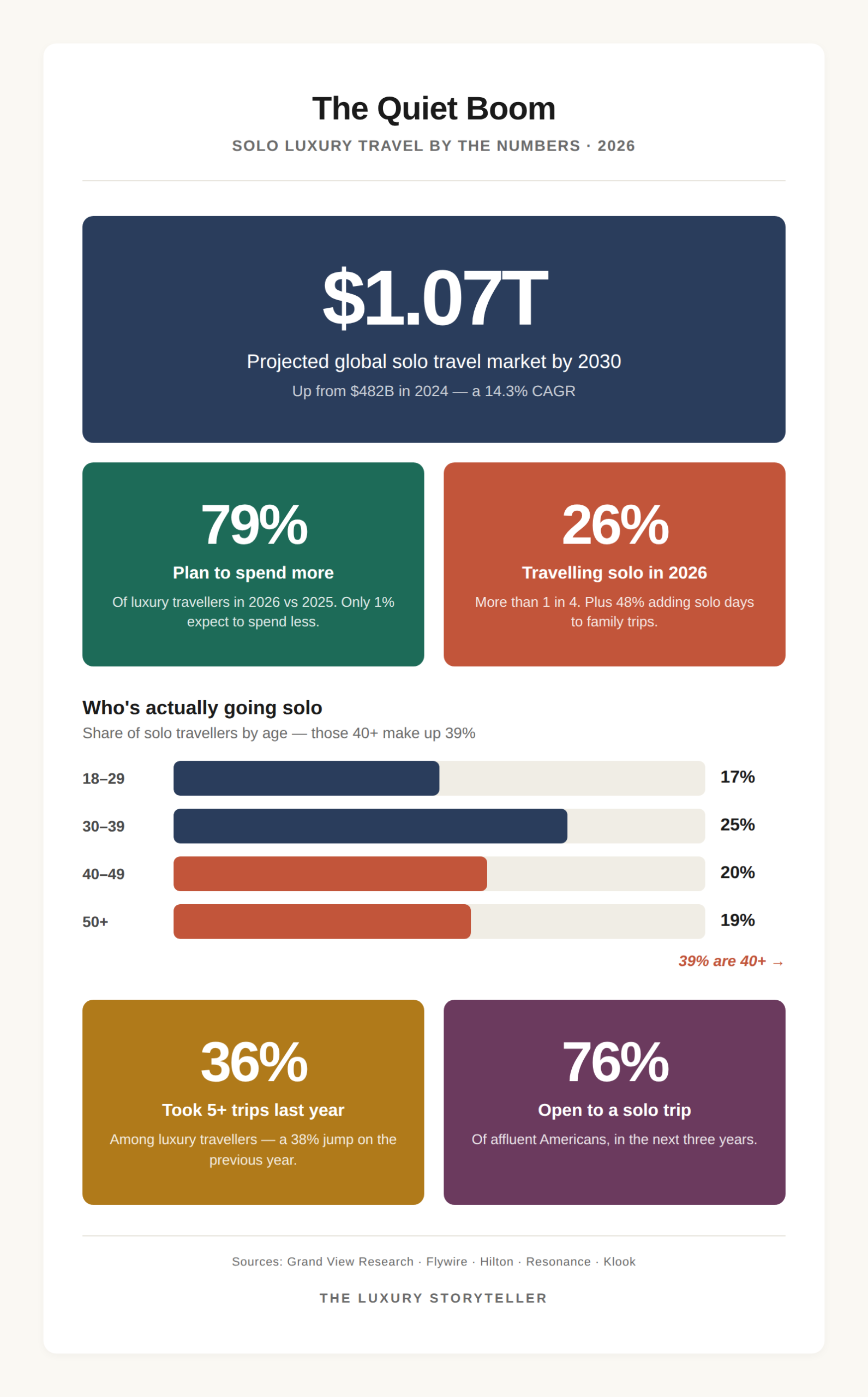
The numbers tell a story the marketing departments haven’t quite caught up to yet. So I’ve pulled them together below, and built a chart you can save, share, or quietly send to anyone still pitching you a “girls’ trip to Mykonos.”
The market that nobody’s quite calling by its name
Start with the headline figure, because it’s a big one. The global solo travel market was valued at roughly $482 billion in 2024 and is projected to climb to around $1.07 trillion by 2030 — a compound growth rate of 14.3% per year. That isn’t a niche. That’s a structural shift in how the leisure economy works.
Within that, the most telling stat doesn’t come from a travel report at all. It comes from Flywire’s survey of more than 500 luxury travellers, published in January: 79% plan to spend more on travel in 2026 than they did in 2025. Only 1% plan to spend less. The highest-spending cohort — those dropping $25,000 or more per trip — saw their share of frequent travellers (five or more trips a year) jump 38% year on year.
These are not people booking last-minute Ryanair flights to Faro.
Where the 40+ traveller actually fits
Here’s the bit that gets buried. The breakdown of who’s travelling solo, by age, looks roughly like this:
- 18–29: 17%
- 30–39: 25%
- 40–49: 20%
- 50+: 19%
Add the bottom two together and you get 39% of the entire solo travel market sitting in the 40-plus bracket. That’s a bigger slice than the 30-somethings everyone keeps writing about, and very nearly as big as the 18–39 group combined.
These travellers also behave differently. Per the 2026 Solo Female Travel Survey, women in this age bracket worry less about safety than younger travellers (59% vs 69%), find themselves in fewer dangerous situations, and have done it before — 37% have already taken more than ten solo trips. They aren’t chasing Instagrammable spots. They’re choosing destinations on cultural depth, beauty, and what the trip actually feels like once you’re there.
This, broadly, is the profile that built The Luxury Storyteller’s audience. And the data finally caught up.
What this cohort actually wants
Hilton’s 2026 Trends Report — which surveyed travellers globally — landed on a phrase that almost made me laugh out loud: “hushpitality.” Yes, really. But strip away the portmanteau and the underlying finding is sound. The number one motivation for leisure travel in 2026 is “to rest and recharge” (56%), followed by time in nature (37%) and improved mental health (36%).
More than one in four travellers (26%) plan to take a solo trip in 2026. And here’s the bit nobody saw coming: 48% are adding solo days onto family trips — before or after — to carve out their own quiet.
Resonance Consultancy’s 2026 Future of Luxury Travel report, which has been tracking affluent American travellers since 2007, found something similar but sharper. Among the top 1% of US households, 34% are now planning a trip primarily for health and wellness, up from 23% in 2019. Cruising interest among the same group jumped from 37% to 53% over six years — which is why Four Seasons, Ritz-Carlton, and Aman are all rushing to launch yacht collections.
The pattern is consistent across every credible report I’ve read: this is a cohort spending more, travelling more often, and prioritising depth over spectacle.
The opportunity nobody’s properly serving
There’s a quote in the Solo Female Travelers Club survey that stuck with me. One respondent said: “To advertise it as a ‘girls’ trip’ is demeaning. I would like solo female travelling to be unquestioned and to not make it such a big deal.”
That, in a sentence, is the gap. The travel industry still markets to couples and families by default, then bolts on “solo packages” as if they’re a remedial offering. But the 40+ solo traveller — affluent, experienced, deliberately choosing to go alone — isn’t a niche to patch over. They’re a structural foundation of the leisure travel economy. Resonance went as far as calling them exactly that.
For brands paying attention, the implications are clear. Drop the single supplement (or at least make it reasonable). Stop showing two glasses on the terrace. Build for one — properly — and recognise that “one” might be a 52-year-old who’s done this seventeen times before and has very firm views on bedside lighting.
What I’d do with this if I were planning 2026
Three things, in rough order:
- Book later, but commit harder. The data on luxury travellers shows shorter lead times and higher per-trip spend. Translation: the market is pricing for spontaneity, and discounts on prepaid non-refundable rates are real (60% of luxury travellers said they’d take that trade).
- Lean into quiet over spectacle. Reading retreats, silent stays, slow itineraries — these aren’t fringe. Literary tourism alone is forecast to grow from $2.4B to $3.3B by 2034.
- Pick the place, not the trend. The most-searched solo destinations in 2026 (Australia, Japan, New Zealand, Costa Rica) are all places that reward a solo traveller with depth — culture, nature, and infrastructure that doesn’t punish you for arriving alone. Tripadvisor’s top solo city for 2026 is Dublin, of all places, and the reasoning is simply that it’s welcoming and easy. That’s underrated.
I’ll be writing more about specific destinations, properties, and itineraries that fit this profile over the coming weeks including a few from the Secluded Stays portfolio that genuinely deliver on the “solo, but not lonely” brief.
In the meantime, the chart’s up top. Save it, share it, send it to whoever still thinks the solo travel market is younger than they are.
Spoiler: it isn’t.