









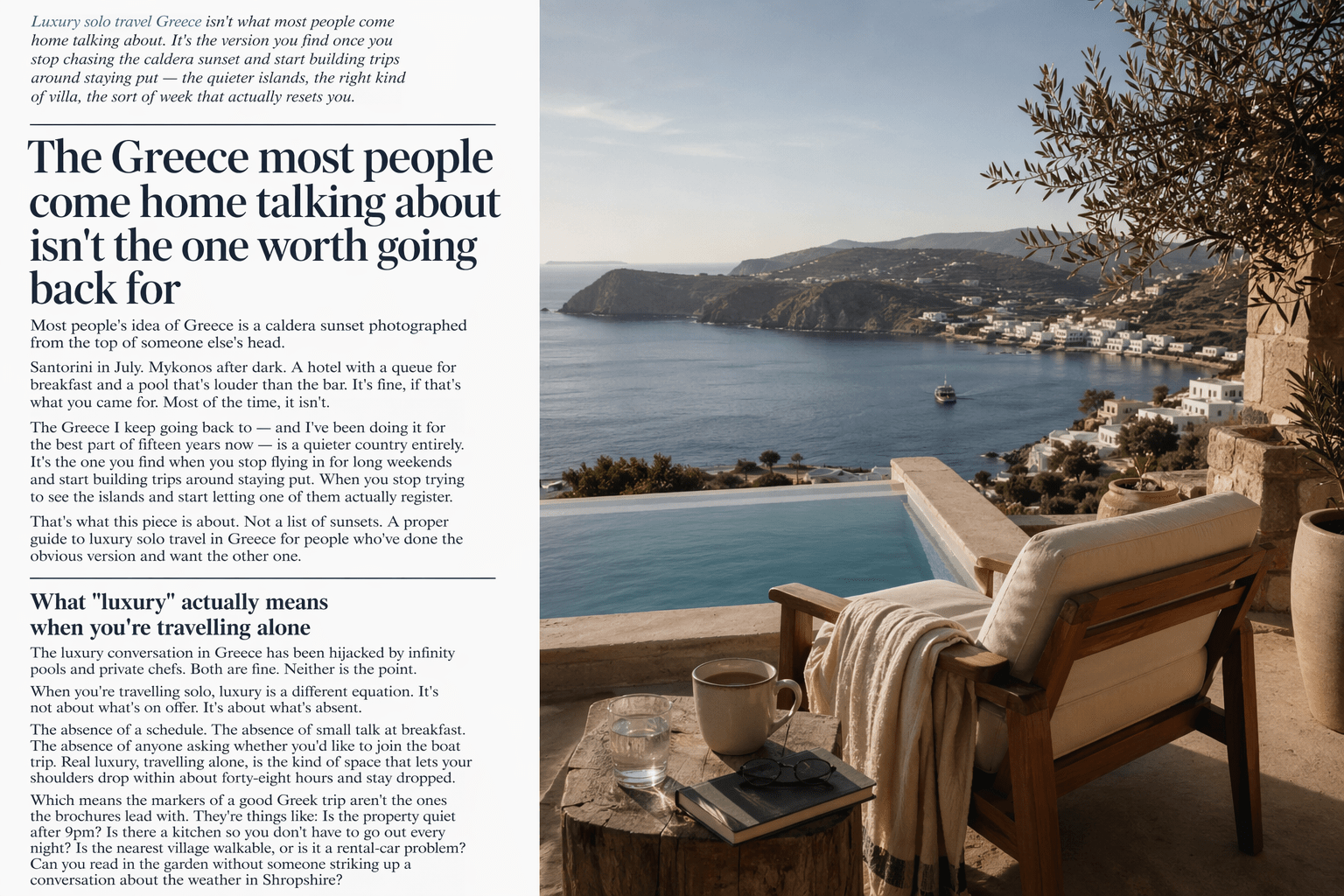

Luxury solo travel Greece isn’t what most people come home talking about. It’s the version you find once you stop chasing the caldera sunset and start building trips around staying put — the quieter islands, the right kind of villa, the sort of week that actually resets you.
The Greece most people come home talking about isn’t the one worth going back for
Most people’s idea of Greece is a caldera sunset photographed from the top of someone else’s head.
Santorini in July. Mykonos after dark. A hotel with a queue for breakfast and a pool that’s louder than the bar. It’s fine, if that’s what you came for. Most of the time, it isn’t.
The Greece I keep going back to — and I’ve been doing it for the best part of fifteen years now — is a quieter country entirely. It’s the one you find when you stop flying in for long weekends and start building trips around staying put. When you stop trying to see the islands and start letting one of them actually register.
That’s what this piece is about. Not a list of sunsets. A proper guide to luxury solo travel in Greece for people who’ve done the obvious version and want the other one.
What “luxury” actually means when you’re travelling alone
The luxury conversation in Greece has been hijacked by infinity pools and private chefs. Both are fine. Neither is the point.
When you’re travelling solo, luxury is a different equation. It’s not about what’s on offer. It’s about what’s absent.
The absence of a schedule. The absence of small talk at breakfast. The absence of anyone asking whether you’d like to join the boat trip. Real luxury, travelling alone, is the kind of space that lets your shoulders drop within about forty-eight hours and stay dropped.
Which means the markers of a good Greek trip aren’t the ones the brochures lead with. They’re things like: Is the property quiet after 9pm? Is there a kitchen so you don’t have to go out every night? Is the nearest village walkable, or is it a rental-car problem? Can you read in the garden without someone striking up a conversation about the weather in Shropshire?
Get those right and the rest sorts itself out.
The island question: where to actually go
Greece has somewhere between 200 and 6,000 islands depending on who’s counting and what counts. For a solo luxury trip, most of them are wrong. A handful are extraordinarily right.
Here’s how I’d split them.
The Ionians: where I’d send almost anyone first
The Ionian islands sit on the western side of the country, which matters more than it sounds. The light is softer, the landscape is greener, and the pace has never quite caught the Cycladic fever. Corfu, Paxos, Lefkada, Kefalonia, Ithaca, Zakynthos, Meganisi — each with its own temperament, most of them still un-performed.
I’ve based myself in Parga on the mainland opposite for years — technically Epirus, functionally the Ionian gateway — and the islands off that coast are where I send people who want Greece without the Instagram tax. Paxos for quiet sophistication. Kefalonia for scale and contrast. Meganisi for the feeling of having slipped through a gap in the schedule.
If you’ve only got one Greek trip in you this year and you want it to work as a solo luxury escape, start here. I’ve written a full Ionian Islands guide as a companion to this piece — it goes island by island.
Naxos and the quieter Cyclades
The Cyclades aren’t all Mykonos. Naxos in particular is a genuinely good solo destination — large enough to have a real economy that isn’t tourism, small enough to be navigable, and mercifully underbuilt on its west coast. Long beaches, proper tavernas, and a main town that functions as a town rather than a stage set.
Paros works too, if you avoid Naoussa at weekends and stay somewhere with its own outdoor space. Sifnos for food. Folegandros for silence. Skip Mykonos unless you’re going for the noise on purpose.
Crete, for the ones who want more space than island
Crete is the outlier. Big enough to feel like a country, varied enough to do a whole trip inside it, and well-supplied with the kind of countryside villas that make solo travel feel like a sabbatical rather than a holiday. The west — Chania, the Akrotiri peninsula, the villages behind Sfakia — is where the quieter luxury sits.
Where not to go alone (at least not for this kind of trip)
Santorini isn’t built for solo downtime. Mykonos isn’t trying. Rhodes old town is beautiful for a day and exhausting for a week. Corfu town is the same. None of them are bad places. They’re just the wrong tools for this particular job.
Planning luxury solo travel Greece: villas, not hotels
If you take one thing from this piece, take this: when you’re travelling solo in Greece and looking for the version of the trip that actually resets you, a villa beats a hotel almost every time.
A good hotel gives you service. A good villa gives you a life, temporarily. The second one is what you want.
What to look for:
- Two bedrooms or fewer. Bigger villas are built for groups and feel odd with one person in them.
- Its own pool or direct sea access. Shared pools drag the whole experience back towards hotel-land.
- A proper kitchen and outdoor dining space. Half the pleasure of Greece is eating at your own table with a bottle of something local.
- Within walking distance of a village, or with a confident owner/manager who can handle the logistics.
- Off the main road. The difference between “five minutes from the beach” and “five minutes from the main road to the beach” is the whole trip.
A few hotels do the solo luxury thing well — small, boutique, with proper gardens and no animation programme. In the Ionians they exist. In Crete they exist. In Santorini they’re priced like Manhattan and booked eighteen months out. For the rest, go villa.
I keep a running shortlist of the ones I’d actually stay in myself, mostly in the Ionians and Crete, and I’ll occasionally feature last-minute availability in The Refined Edit.
How a good solo day unfolds
The trap with solo travel is over-engineering it. You land with a list, the list becomes a schedule, the schedule becomes the thing you’re trying to complete, and by Wednesday you’re tired in the way you were at home.
This is what luxury solo travel Greece looks like when you stop treating it as a checklist.
Mornings tend to be the best part of the day. Up before it’s hot, coffee somewhere outside, a swim if the sea is close, a long breakfast that isn’t being served to you. By eleven you’ve already had more morning than most people get in a week.
Middle of the day collapses into itself. Lunch, either something you’ve picked up from the village or something simple at a taverna where nobody’s trying. Then the Greek afternoon happens to you whether you planned it or not — a couple of hours where the light is too strong and the sensible thing is to be horizontal.
Evenings stretch. Dinner starts late and finishes later. Walks home in the dark. The kind of tiredness that isn’t tired.
Three or four days of that and something shifts. You notice it on the drive to the airport, usually. You’re not in a hurry about anything.
Practical things, briefly
When to go. May, June, and September are the windows. July and August are hot, busy, and priced accordingly. October is quietly excellent and most people have already left.
How long to stay. A week is the floor. Ten days is better. Less than a week and you spend half of it adjusting.
Getting around. One island, properly, beats three islands in a hurry. If you must hop, pair islands that share a ferry route rather than trying to cross the country.
Solo dining. Not an issue in Greece. Tavernas are used to single diners and most of the good ones will happily sit you somewhere you can eat without being stared at. Bring a book. Order more than you think you need.
Safety. Greece is one of the easier countries in Europe to travel alone. The standard precautions apply and that’s about it.
Is Greece a good place for luxury solo travel?
Yes — but with a caveat. Greece rewards the version of you that’s willing to slow down and punishes the version that’s trying to pack it in. If you come at it like a checklist, it’ll feel crowded and expensive. If you come at it like a retreat, it’s one of the best places in the world to be alone on purpose.
The difference isn’t the destination. It’s the shape of the trip.
FAQ
What’s the best Greek island for a solo luxury trip?
For most people, the Ionians — Paxos, Kefalonia, or Meganisi in particular. They’re quieter than the Cyclades, greener, and better suited to the kind of villa-based, slow-paced trip that works solo. Naxos is the best of the Cyclades for this. Crete is the best for longer stays.
Is Santorini worth it for solo travellers?
Not for this kind of trip. Santorini is built around its view, which means it’s built around crowds at sunset and prices at all times. If you’ve always wanted to see it, go in April or October, stay two nights, and treat it as a stop rather than a trip.
Is Greece expensive for solo travellers?
Less than you’d think, outside the famous spots. Villa rates in the Ionians or Crete compare favourably with mid-range hotels in Italy or France, and eating out is still materially cheaper than most of Western Europe. The main cost is the single supplement on anything hotel-shaped, which is another reason villas win.
Is Greece safe for solo travel?
Yes, it’s consistently one of the safer European destinations for solo travellers, including women travelling alone. Small islands in particular function on the assumption that nobody’s a stranger for long.
When should I go to avoid the crowds?
Mid-May to mid-June, or the second half of September through October. The weather is still generous, the sea is warm, and the islands behave like themselves again.