








There’s a particular silence that arrives in your forties. Not loneliness, exactly — more a recognition that the noise of the previous two decades has thinned out, and what’s left is the quiet question of what you actually want to do with your time.
For a lot of men I know, the answer is: travel. Not the dutiful family logistics of the school-holiday years, and not the lager-soaked group trips of one’s twenties. Something else. Something that, for want of a better phrase, looks more like a life well-lived than a holiday.
This is the trip that almost nobody writes about properly.
The luxury solo travel space is, frankly, dominated by two voices: the thirty-something woman with a curated Instagram grid, and the seventy-something widow on a Saga river cruise. Men in their forties and fifties who travel alone are largely missing from the conversation — not because they don’t exist, but because the industry hasn’t quite worked out what to sell them. The result is a strange editorial vacuum.
I’d like to fill it.
Why men over 40 are quietly becoming the most interesting solo travel demographic
The numbers tell their own story. Solo travel has roughly doubled as a share of bookings in the past five years, and while women still outnumber men, the male share is rising faster. Globus reported that 63% of men in their survey were embracing solo travel, compared to 54% of women. The stigma — and there was one — is dissolving.
The reasons are fairly easy to map. Divorce rates for men over 40 have climbed. Empty-nest milestones now arrive for parents who had children later. Remote work has loosened the geographical leash. And a generation that grew up associating luxury with status has, by 40, generally worked out that the better metric is space — physical, mental, temporal.
What men in this bracket want from travel is, in my experience, fairly consistent:
- Privacy without isolation
- Beauty without performance
- Logistics that disappear
- The option of company, but not the obligation of it
- Food and surroundings that don’t require an apology
What they don’t want is a coach tour, a name badge, or a forced “singles’ meet and greet” where the only available conversation is about someone else’s ex-wife.
The honest problem with most “luxury solo” content
If you Google “luxury solo travel” today, you’ll find roughly the same eight destinations recycled across every glossy travel publication: Iceland, Japan, Costa Rica, Portugal, Italy, New Zealand, Norway, Morocco. They’re all fine. They’re also all written for the same notional reader — usually a thirty-something woman planning her first trip alone.
The deeper issue is that most luxury solo content treats the solo part as a bug to be designed around. Hence the relentless focus on group tours that “feel solo” and resorts that “make solo travellers feel welcome”. Both of which are perfectly valid options, but neither of which addresses the man who actively wants to be alone — and wants to be alone somewhere beautiful.
This is the gap. And it’s a gap that, with a bit of thought, is genuinely simple to fill.
What “luxury” actually means when you’re travelling alone
I’ll be direct: a five-star hotel is often the worst possible choice for a solo male traveller. You eat in a dining room that’s been laid out for couples. You sit at the bar feeling, fairly or otherwise, conspicuous. The pool deck is full of families. Nothing about the architecture has been designed for one.
Luxury, when you’re solo, has different load-bearing components:
Space you control entirely. A villa, a private cottage, a remote lodge. Somewhere you can wake up, make coffee, and not perform sociability before 11am.
A staff who treat you like an adult. No pity, no patronage, no “table for one, sir?” with a slight head-tilt.
Proximity to texture. A working market, a coastline, a forest, a town with a pulse. Solo travel turns flat when you’re stuck in a resort bubble — you need somewhere to walk into.
Food you can take seriously. This is the single most underrated factor. Solo dinner in a great restaurant is one of life’s quiet pleasures. Solo dinner in a mediocre hotel buffet is a punishment.
The option to do nothing. The defining luxury of travelling alone is the absence of consensus. No one to coordinate with, no one to placate, no one to wait for. The right accommodation makes that delicious rather than awkward.
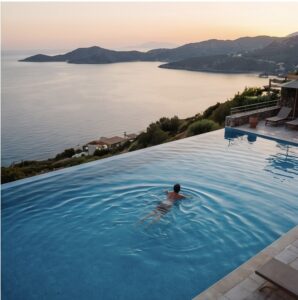
This is, incidentally, why villa stays have become the quietly dominant format for men in this bracket. You get the privacy of home with the geography of holiday. You can read for two days without speaking to anyone, then walk into a coastal town for a long lunch. The villa absorbs the solo question and stops it from being the defining feature of the trip.
Destinations that work — and a few that genuinely don’t
I’m going to be more useful here than the standard listicle. Rather than giving you ten destinations with three sentences each, here are four archetypes, each of which suits a slightly different version of the trip you might want.
The Ionian Islands (Kefalonia, Meganisi, Lefkada)
If you want to test the format with one trip: this is it. The Ionians give you the texture of Greece without the volume of Mykonos or Santorini. Meganisi in particular is a small island where you can rent a villa, walk to a taverna in fifteen minutes, and not see another tourist for half a day. Kefalonia has more infrastructure, better restaurants, and a ferry network that lets you island-hop without a plan. It’s the rare destination that rewards both the introvert and the curious.
Portugal — Algarve and Alentejo
The Algarve has a reputation problem (over-developed, Brits abroad, lager). Most of that reputation belongs to a five-mile strip near Albufeira. Move thirty minutes inland or thirty miles east, and you’re in another country entirely. The Alentejo, in particular, is one of Europe’s last properly under-touristed luxury destinations — vineyards, slow-cooked food, herdade estates that rent as villas, and a coastline (around Comporta and the Costa Vicentina) that is genuinely empty.
Scottish Highlands and the Western Isles
The unfashionable choice that men in their fifties tend to discover and then never stop talking about. A lodge on Skye, Harris, or one of the Argyll lochs gives you weather, walks, whisky, and a kind of solitude that simply does not exist in Mediterranean Europe. Pair it with a few days in Edinburgh on either side and you have a trip that costs less than a week in Tuscany and leaves a deeper mark.
Japan — but not the Japan you’ve read about
Tokyo and Kyoto are extraordinary, and also exhausting if you’re solo. The version of Japan that suits a solo male traveller in his forties is the rural one: a few nights in a ryokan in the Kiso Valley, a stretch of the Kumano Kodo pilgrimage trail, an onsen town like Kinosaki where solo dining is built into the architecture. This is Japan as a recovery, not a sightseeing campaign.
What to skip
Caribbean all-inclusives, anything marketed as “couples retreat”, Las Vegas, large cruise ships, and most of what Instagram has ranked. None of these are designed for you. Many of them are designed against you.
The single supplement question, briefly
Yes, it’s a tax on travelling alone. Yes, it’s annoying. The cleanest way around it is to skip the tour-and-cruise model entirely and rent a villa or a small lodge directly. Per night, a private villa for one is often cheaper than a five-star hotel room — and it’s qualitatively a better experience. Last-minute villa availability, in particular, has become a real arbitrage opportunity in the past two years; properties that sit empty cost owners money, and the rates reflect that.
This is, transparently, a thing I work on at Secluded Stays but the point stands whether you book through us or not. The villa-vs-hotel maths for solo travellers has fundamentally shifted.
A few practical notes I wish someone had told me
Book the table before you arrive. Solo dinner reservations at good restaurants are easier to get than couples’, because most places hold a few seats at the bar or pass. Email directly rather than using a booking platform.
Pack for the weather, not the photographs. No one is looking at you. This is the whole point.
Build in one anchored experience per trip. A cooking class, a guided walk, a wine-tasting. Not because you need company, but because it gives the week a spine.
Don’t over-plan. The defining mistake of new solo travellers is treating the trip like a couples’ itinerary minus one person. The whole point is the latitude.
Tell someone where you are. This is not a safety paragraph; it’s a friendship one. Send your sister or your closest friend a photo a day. It costs nothing and it changes the texture of the trip.
The trip you’re actually planning
The point of all of this isn’t really the destination. It’s that travelling alone in your forties and fifties is one of the few genuinely countercultural acts left. It refuses the family logistics, the couples’ formats, the group-tour aesthetic, and the grim implication that men of a certain age should be settled, partnered, and content.
You can be all of those things, of course. Most of the men I know who travel solo also have full lives at home. The trip isn’t an escape from anything. It’s a reminder that the life you’ve built has space inside it for something this quiet.
That’s the trip worth taking.
This is part of an ongoing series on solo travel at The Luxury Storyteller. If you’d like the next piece in your inbox, The Refined Edit goes out fortnightly