






Most people who ask me about Naxos solo travel get the same answer: you’re not thinking about it enough.
Not Santorini, engineered as it is for the couples photograph. Not Mykonos, which has spent the last decade perfecting the art of making anyone without a group feel slightly superfluous. Not Corfu in August, which is fine but not what you’re going for.
Naxos
I’ve been twice now, at different times of year, and the thing that strikes me each time is how well the island wears solitude. Not in a melancholy way — in the way that places with genuine depth wear it. There’s enough here for a week of serious attention: a harbour town worth getting lost in, mountain villages that have been operating at the same pace for centuries, beaches that range from convivial to completely empty depending on how much driving you’re prepared to do, and a food scene that is, without exaggeration, some of the best I’ve encountered anywhere in the Cyclades. When you’re travelling alone and you have nothing to do except pay attention, Naxos rewards that.
Here’s what to know before you go.
Why Naxos works for solo travel over 40

The Greek island that works for solo travel over 40 needs to satisfy a fairly specific set of conditions. It needs a town with genuine social infrastructure — somewhere to eat alone without the architecture of the restaurant making you feel like an anomaly, somewhere to sit with a drink and watch the world without being the subject of anyone’s concern. It needs accommodation at the quality end that doesn’t feel designed exclusively for couples. It needs depth — enough to fill a week at a slow pace without having to manufacture activity.
Naxos satisfies all three in a way that most of its neighbours don’t.
The harbour town, Chora, is large enough to have real variety — proper restaurants, a Venetian castle quarter worth an evening’s wandering, a port with the kind of ambient activity that makes sitting alone feel natural rather than conspicuous — but small enough that you learn its rhythms quickly. By day three, you have a coffee place, a wine bar, a preferred table. That familiarity, arrived at without effort, is one of the quiet pleasures of solo travel on a mid-sized island.
The food is the other thing. Naxos is the agricultural island of the Cyclades — it actually grows things, which most of its neighbours don’t. The potatoes are famous (genuinely; this is not tourist copy). The cheese — graviera, arseniko, the sharp local xinomizithra — is produced on the island and turns up in everything. The wine is taken seriously. The result is a food culture that has earned its quality rather than assembled it for visitors, and that difference is detectable in every family-run taverna that’s been feeding locals since before the tourist trade arrived.
For the solo traveller over 40 who eats well, Naxos is a serious destination in a way that Santorini, for all its views, simply isn’t.
Getting there and getting around
Naxos has an airport (JNX) with direct connections from Athens, which is the sensible approach — the ferry from Piraeus takes five to six hours and while it’s a genuine experience, it’s a lot of time. Flying from Athens takes forty minutes.
The transport picture on Naxos is better than most guides suggest. The bus network in summer runs regularly along the main beach corridor — Naxos Town to Agios Prokopios, Agia Anna, and Plaka — and the schedules are frequent enough to be genuinely useful rather than merely theoretical. For a solo traveller based in Chora who wants beaches and restaurants, the bus is a perfectly reasonable way to operate.
Where a car earns its keep is the interior. The mountain villages — Apeiranthos, Filoti, Halki — are either not on the bus network or served infrequently enough to make a day trip impractical without one. The quieter southern beaches beyond Plaka are similarly car-dependent. If you want to explore the island properly rather than stay within the beach corridor, hire a car for two or three days rather than the full stay. Automatics are available but book ahead — they’re scarcer than manuals. A UK licence is accepted without issue at most hire companies.
Where to stay
The accommodation picture on Naxos has improved significantly in recent years, and there’s now a genuine quality option at every point of the solo travel spectrum.
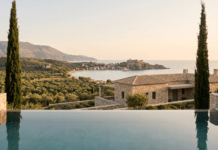
If you want the closest thing to a private villa experience: the Naxian Collection, outside Naxos Town near Agios Prokopios, is the standout property on the island. Private villas and suites with their own pools, an organic kitchen garden, a wine cellar that justifies the trip on its own terms, and a genuinely hospitable family operation behind it. It’s the kind of place that gets better the longer you stay — staff who give you restaurant recommendations that aren’t on any list, local knowledge that no amount of research replicates. As a solo traveller, the villa format here works particularly well: you have your own space completely, with hotel-level service available when you want it and entirely absent when you don’t.
If you want to be in the town: Hotel Grotta, just above the old town with views of the Portara and the sea, is the most characterful option in Chora. Small, well-run, well-positioned for everything walkable. The Venetian Suites in the old town itself put you inside the castle quarter — compact rooms but an extraordinary sense of place.
For the beach without complete isolation: the Stelida area, south of the airport, has the highest concentration of quality boutique properties. Villa Marandi, a sixteen-suite property on its own beach, is particularly good for solo travellers — small enough to feel personal, with staff who treat a guest travelling alone as a guest rather than a category.
One general principle: on Naxos, wherever possible, stay somewhere with an outdoor space that’s genuinely yours. A terrace, a garden, a pool — the quality of your mornings depends on this more than anything else.
What to do: a week’s worth of slow attention
Chora and the old town
Start here and give it more time than you think you need. The Kastro — the Venetian castle quarter at the top of the old town — is a maze of narrow alleys, crumbling fortifications, and a handful of excellent restaurants tucked into spaces that seem impossible to cook in. The Archaeological Museum here is small but genuinely good: Cycladic figurines and early Bronze Age finds that give the island its proper historical weight.
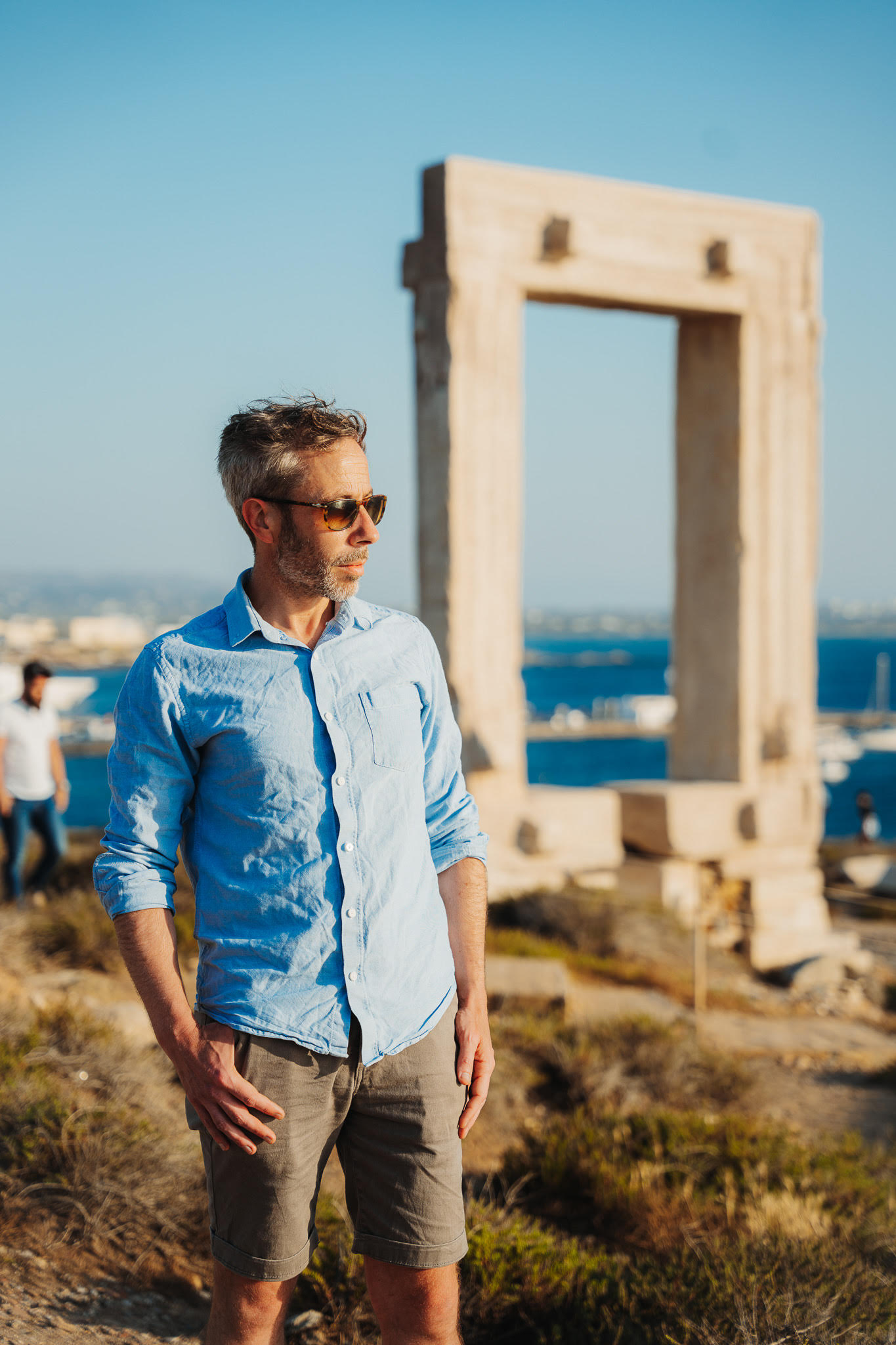
The Portara — the enormous marble doorway of an unfinished temple to Apollo, standing alone on a small peninsula at the entrance to the harbour — is worth an hour at sunset. It’s Naxos’s most photographed landmark for good reason, and it’s one of those rare cases where the photograph does not adequately prepare you for the thing itself.
The mountain villages
This is where Naxos separates itself from every other Cycladic island and makes the strongest case for coming with a car and going slowly.
Apeiranthos is the most remarkable — a marble-paved village at 700 metres, cool even in summer, with a distinct character that feels Venetian and Cretan simultaneously. The local museum (small, free, worth it) covers the island’s emery-mining history. There are two or three tavernas; eat at whichever one looks like it’s been there longest.
Halki is the prettiest — a former capital with neoclassical tower houses, a Byzantine church, and the Vallindras distillery producing Kitron, the citrus liqueur made exclusively from Naxos citron trees. The tasting is free and the liqueur is better than it sounds.
Filoti, the largest village in the interior, sits at the foot of Mount Zas — the highest peak in the Cyclades, and a straightforward two-hour hike if the weather is right. The view from the top explains the island’s mythology.
Allow a full day for the mountain circuit. Take the eastern route up and the western route down, or vice versa. Stop when something looks interesting. This is the day a solo trip earns its keep.
The beaches
Naxos has a long western coastline of almost unbroken sand, which makes beach choice a matter of temperament rather than logistics.
Agios Prokopios and Agia Anna are the busiest — well-organised, shallow water, good beach tavernas, social in the way that works well for solo travellers who want the option of company. The infrastructure is good; the solitude is not.
Plaka is the middle ground — longer, wider, quieter, with beach bars spaced far enough apart that you can find a stretch of sand with no particular organisation to it. This is where I tend to end up.
Mikri Vigla and Kastraki, further south, are progressively quieter and windier — Mikri Vigla in particular is a kite-surfing destination, which gives it an energy quite different from the northern beaches. Beautiful in the right mood.
The honest advice: drive south until the road gets interesting, park, and walk. The beaches you find that way are usually better than the ones with names.
A cooking class
Naxos’s food culture is serious enough to warrant a half-day engagement with it rather than simply eating your way through it. The half-day cooking class at Basiliko Family Taverna — run from a small inland village, focused on proper Naxian dishes — is the most consistently recommended option on the island. Book ahead; it fills up. For solo travellers, it’s also one of the best social touchpoints of a week here: small groups, genuine activity, the kind of conversation that happens naturally when you’re doing something together.
Where to eat
The short version: almost anywhere family-run and away from the port’s front row.
The longer version:
Metaxi Mas, in the old town, is the local institution — meze format, reliable quality, tables on the cobblestones in the evening. Order the zucchini balls and the spicy meatballs. Arrive early or book; it fills up without drama and without apology.
To Elliniko, also in Naxos Town, is the one for slow-cooked meat and genuine Naxian comfort food. Lamb kleftiko, grilled octopus, stifado. The kind of place where the food has been made by the same family for long enough that the recipes have stopped being recipes and are just knowledge.
O Galanis, in the village of Koronos in the north of the island — worth the drive specifically. A tiny taverna, cash only, famous for its Naxos fries (which are not like other fries) and meatballs. The kind of discovery that justifies having a car.
For the mountain villages: eat in Apeiranthos, at whichever taverna is open. The quality of the ingredients — local cheese, local wine, vegetables from the surrounding fields — means even the most modest kitchen here produces food that tastes like somewhere.
On the food note worth knowing: Naxos produces its own Kitron liqueur from local citron trees — served cold as a digestif in most restaurants, sometimes complimentary, always worth accepting. It tastes like a more civilised limoncello.
The solo travel reality on Naxos
A word on what the experience actually feels like, because it’s worth being specific.
Naxos is not a destination that makes being alone feel like a statement. It’s busy enough, varied enough, and culturally relaxed enough that a solo traveller — of any age — is simply another person on the island. The family-run taverna culture, which is the backbone of the food scene, is particularly accommodating: a table for one is a table for one, you are fed well, and nobody organises a group sing-along to cheer you up.
The mountain villages are, if anything, better solo than in company. You move at your own pace, stop when you want to stop, spend an hour in a village square with a coffee and a book without negotiating anyone else’s boredom. The interior of Naxos rewards this kind of attention in a way that the beach doesn’t require it.
The one adjustment worth making: in high season (July and August), book restaurants in the old town in advance. Naxos is popular enough now that the better places fill up, and arriving alone at 9pm to find a two-hour wait is a different experience than it would be with company. Outside those months, the island operates at a pace that suits solo travel particularly well — shoulder season on Naxos (May, June, September, early October) is genuinely one of the better travel experiences in the Mediterranean.
Practical notes
When to go: May, June, and September are the ideal months. July and August are hot, crowded on the beaches, and slightly chaotic in Chora. October is excellent if you don’t need swimming weather.
How long: Five nights minimum, seven is better. Less than five days and you’re skimming rather than landing.
Getting around: Hire a car. Budget around €40–60 per day for a small automatic in shoulder season, less off-peak.
Money: Card payments are widely accepted in Naxos Town and tourist-facing businesses. Cash is useful for village tavernas, market stalls, and anything that’s been operating long enough to not have needed a card machine yet.
Language: English is widely spoken in Naxos Town and anywhere tourist-adjacent. In the mountain villages, a few words of Greek are appreciated and will get you further than a translation app.
Getting there from the UK: Fly London to Athens (2h45 direct on multiple carriers), then Athens to Naxos (40 minutes, several daily with Sky Express and Olympic). Alternatively, Athens to Naxos by high-speed ferry (3.5 hours) is the scenic option and works well if you’re building a longer Greece trip.
Where to start planning
- Accommodation: The Naxian Collection for the villa experience; Hotel Grotta for the town. Both book up in summer, reserve early
- The broader picture: Naxos fits naturally into a longer Greek islands itinerary, Paros is a short ferry away, and the two islands together make an excellent ten-day solo trip.,
- Stay informed: First-hand destination notes from the field including the Ionian islands this summer in The Refined Edit.