







A Greek island villa solo over 40 is one of those travel decisions that sounds indulgent until you actually do it….
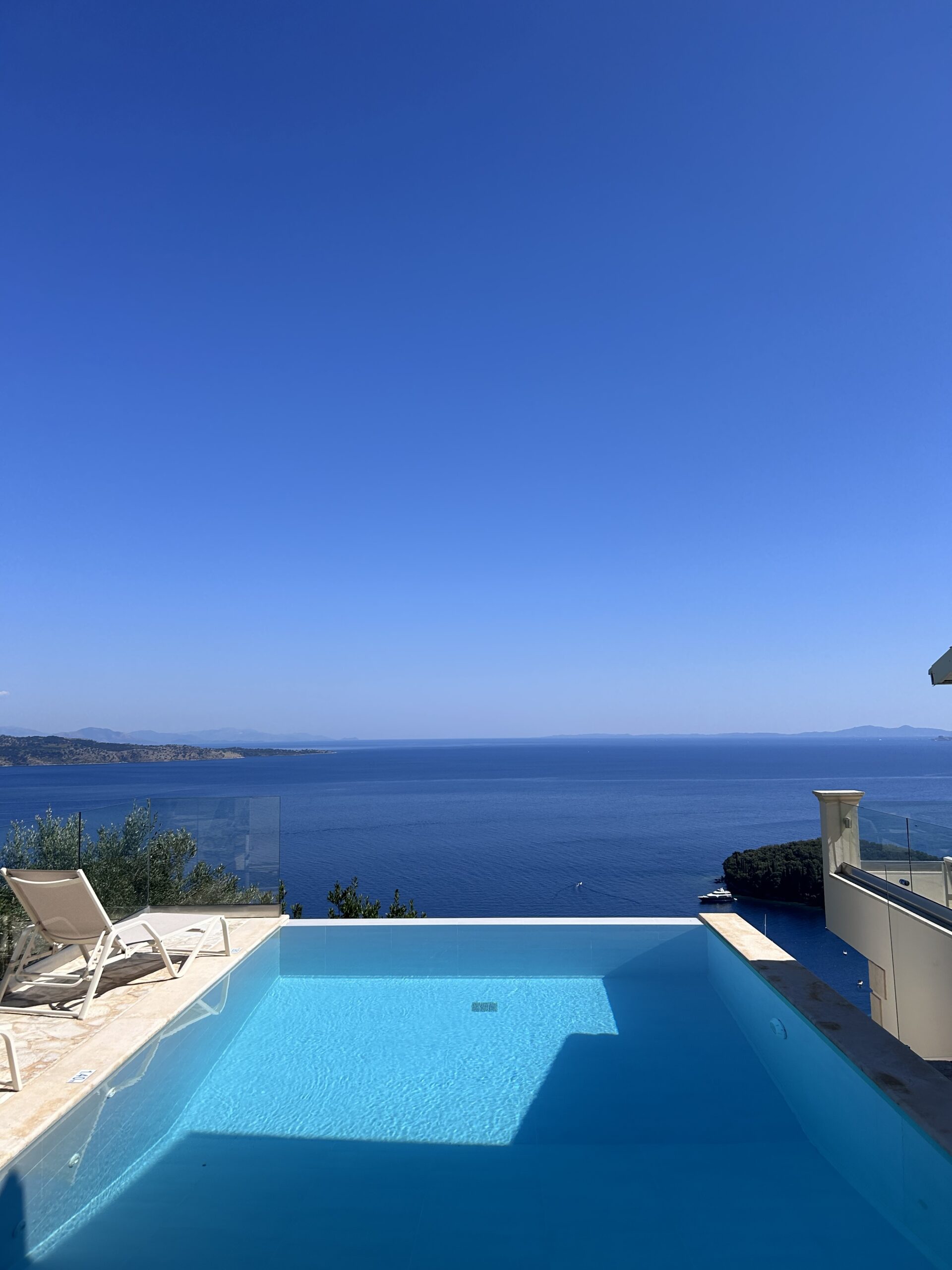
A private pool. A kitchen stocked on your terms. A terrace that belongs entirely to you. The Greek island villa was never just for couples — you just haven’t been told that yet.
There’s a version of Greece that most travel brands haven’t caught up with yet. Not the group tour, not the boutique hotel corridor, not the overbooked Santorini suite. It’s the solo traveller over 40, sitting on a private terrace above a bay that the ferry doesn’t stop at, with a glass of something cold and absolutely nobody else’s schedule to observe.
Villa travel used to require a group to justify itself. The economics demanded it — split the nightly rate seven ways, call it a girls’ trip, pretend the kitchen gets used. That logic has quietly collapsed. The over-40 solo traveller has disposable income, a clear sense of what they want, and no patience for the consolation version of a holiday. A villa isn’t an extravagance for them. It’s a format that finally makes sense.
This piece is for those travellers. The ones who’ve graduated from the room-at-the-back-of-the-hotel and are asking a better question: what does Greece actually feel like when the space is yours?
Why Solo Villa Travel Is Having Its Moment
The data is catching up with what solo travellers already know. In the UK, solo holidays now account for roughly one in five bookings, with the over-40 demographic leading that growth. And the style of trip is shifting — away from the curated tour and toward private, self-directed stays where the pace is entirely personal.
Greece has become a particular beneficiary of this. Its geography helps: hundreds of islands at different scales, each with its own character, a strong villa rental infrastructure built over decades of family travel, and — crucially — a hospitality culture that doesn’t make a single guest feel like a problem to be managed.
But the more interesting driver is psychological. Travelling alone at this stage of life isn’t a compromise. It’s a calibration. You know your own rhythms. You know whether you want to spend the morning at a fish market or the evening at a taverna table with a novel. A villa gives you the architecture to follow those instincts without negotiation.
The single supplement problem — and why villas sidestep it entirely
Hotels charge solo travellers a premium for the privilege of occupying a room at less than full capacity. The single supplement — sometimes 50 to 100 percent of the standard rate — is one of the more revealing signals that the hospitality industry still hasn’t figured out what to do with us.
Villas don’t work like that. You pay for the property. What you do with the bedrooms is your business. A three-bedroom villa booked by one person costs the same as it does for three couples. The mathematics change entirely, and so does the emotional register of the booking.
There’s also no front desk to check in with, no communal breakfast room, no lobby bar where you feel faintly observed. You arrive. It’s yours. That’s it.
What Greece Does Differently for Solo Travellers
Not every destination suits villa-based solo travel equally well. Greece is unusually good at it for a specific set of reasons.
The food infrastructure
A private kitchen is only useful if there’s something worth cooking. Greece — particularly on the islands — has a food culture built around daily shopping. Village bakeries, morning fish markets, agricultural stalls selling produce that was in a field yesterday. Cooking in a Greek villa kitchen for one is one of the more underrated pleasures in European travel. And when you don’t want to cook, the local taverna is almost always better than the resort restaurant and significantly cheaper.
The scale of the islands
Smaller Greek islands suit solo travellers particularly well. The geography keeps everything accessible — you can cover an island on a scooter, a pushbike, or on foot. You don’t need a group to hire a boat for the day. You don’t need to split costs to make a water taxi worthwhile. The terrain does a lot of the social work: beaches are intimate rather than industrial, towns are genuinely navigable, and the sense of discovery doesn’t require a guide.
The cultural tempo
Greek island life moves at a pace that suits the solo traveller who’s deliberately slowing down. Lunch takes two hours. The evening promenade is a fixture, not a performance. Conversations with shopkeepers are actual conversations. There’s no social pressure to be busy, to have plans, to fill your days with activities. A book, a terrace, a very good olive, and the afternoon light off the water — that’s not nothing. That’s the whole point.
Choosing the Right Villa as a Solo Traveller
Not all villas are created equal for solo travel. The questions you ask when choosing a property are slightly different than they would be for a group.
Size versus character
Resist the instinct to book the smallest property you can find to keep costs down. A studio or one-bedroom villa often sacrifices the outdoor living space — the terrace, the pool, the garden — that makes villa travel worth it. A two-bedroom villa with a proper terrace and private pool is almost always the better choice, even if you’re only using one bedroom. The extra space is where the experience happens.
Location logic
For a solo stay, proximity to a village matters more than it might for a group. You want to be able to walk somewhere for a coffee, an evening meal, or simply to feel the ambient life of a place. Complete isolation can tip from peaceful into lonely within 48 hours. The sweet spot is a villa set slightly apart from a village — enough to feel private, close enough to feel connected.
Owner relationships and local knowledge
The best Greek villa stays involve an owner or caretaker who actually knows their island. The recommendation for Tuesday’s fish market, the beach that’s empty on a Thursday morning, the taverna that doesn’t appear on any review platform but has been serving the best grilled octopus for thirty years. Solo travellers benefit more from this knowledge than groups do, because you’re navigating the place alone and local intelligence is genuinely useful rather than decorative.
Arrival logistics
Think carefully about how you get there. Some of the most beautiful properties on Greek islands require a boat connection from a mainland port, a small ferry hop, or a fairly demanding drive from the nearest airport. As a solo traveller, you’re managing all of this yourself. It’s not a reason to avoid remote islands — some of the best villas are on exactly those islands — but it’s a reason to plan the arrival carefully and not treat it as an afterthought.
Finding the right villa as a solo traveller still requires more legwork than it should. That’s a gap worth watching — and one we’re working on.
Practical Notes for First-Time Solo Villa Guests
Timings
May and early June are the standout months for solo villa travel in Greece. The summer crowds haven’t arrived, prices are lower than July and August, the light is extraordinary, and the islands are genuinely alive rather than overwhelmed. Late September and October are equally good for different reasons — the pace slows, the sea is still warm, and the tourism infrastructure has relaxed into its off-season self. High summer (July–August) is fine but requires more tolerance for heat, crowds, and premium pricing.
What to actually do with the time
This is a question solo travellers ask more honestly than group travellers, who paper over it with social activity. The answer depends on what you’re actually running away from. If it’s noise and obligation, then the value of a Greek villa week is mostly in the absence of those things. If it’s a need for genuine discovery, then the island geography rewards movement — you’ll see and experience more than you expect to.
Plan loosely. Book one or two things in advance that require a booking (a boat trip, a particularly sought-after restaurant). Leave everything else improvised. The days fill themselves in ways that group trips prevent.
The solo dinner question
Everyone asks it. The answer, in Greece specifically, is that it isn’t the production it might be in other countries. Greek tavernas are communal by nature — the large table, the shared plates, the proprietor who treats a single diner as a guest rather than an inconvenience. Bring a book if it makes you more comfortable. You probably won’t use it.
When to tell people where you’re going
The standard advice applies. Share your itinerary with someone you trust. Keep your phone charged. Don’t make a virtue of being unreachable — it’s not a personal achievement. Beyond those basics, the Greek islands are among the safest destinations in southern Europe for solo travellers. The anxiety about it is usually more exhausting than the reality.
The Bigger Question Behind the Villa Booking
Choosing to travel alone is a decision that still requires a small act of will for most people. Not because it’s difficult — it isn’t, particularly in Greece — but because we’ve been trained to treat solo travel as either brave or sad, and neither framing is accurate.
The more honest framing is this: a solo villa holiday in Greece is a particular kind of statement about how you want to spend your time and your money. It says you’ve stopped waiting for the group trip that never quite comes together. It says you’re interested in your own company, which is underrated. It says you’ve worked out that the best version of a holiday might actually be the one where every decision — including the decision to do nothing — is yours.
That’s not a luxury for the few. It’s a logic that applies to anyone over 40 who’s been deferring the trip. Greece is very good at reminding you that you didn’t actually need to wait.
Contact us for our range of Greek villas at theluxurystoryteller@gmail.com