





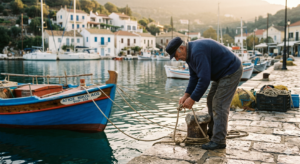
The first thing you notice in Vathy harbour at seven in the morning is the sound of rope against wood — a fisherman tying off a caïque, unhurried, while the water beneath him holds that particular early-Ionian green that photographs always render too blue. Nobody looks up. On Meganisi, your arrival is not an event.
This is precisely why you should come.
The geography of restraint
Meganisi sits a short ferry hop east of Nidri on Lefkada — twenty-five minutes, a handful of crossings a day, timetables that flex with the season and occasionally with the captain’s mood. The island is small enough to walk across in a morning and shaped, on the map, like a tadpole: a fat body of olive groves and three villages, trailing a long, thin tail of cliffs and sea caves to the south. The permanent population hovers around a thousand. In August it swells; by October it exhales.
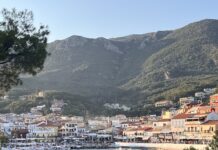
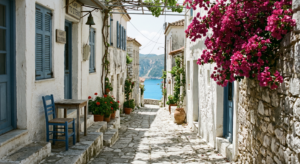
There are three villages worth knowing. Vathy is the working harbour — yachts, fishing boats, a string of waterfront tavernas where the octopus was swimming that morning and the owner will tell you so without ceremony. Spartochori sits high above Porto Spilia, a cluster of whitewashed lanes and bougainvillaea that earns its postcard reputation honestly, then closes its shutters for the afternoon. Katomeri, inland, is where the island actually lives — the bakery, the mini-market, the kafeneio where the same four men have been disagreeing about politics since the Karamanlis years.
After fifteen years of working these waters, I can tell you the Ionian has very few places left where the rhythm is set by residents rather than visitors. Meganisi is one of them, and the islanders seem quietly determined to keep it that way.
Why it works for the solo traveller
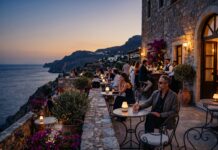
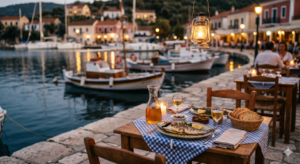
Solo travel in Greece divides into two camps: islands that perform for you, and islands that simply continue around you. Meganisi belongs firmly to the second. There is no scene to be excluded from, no couples’ resort apparatus to navigate, no pity at the table for one. You take your table at Errikos or Porto Vathy, you order the grilled fish and a half-litre of the local white, and within two evenings the waiter knows your order and the woman at the next table knows your name.
This matters more after forty than the travel industry generally admits. The solo traveller at this stage of life is not seeking reinvention or a crowd; they’re seeking quality of attention — from a place, from its food, from its people, and crucially from themselves. Meganisi’s scale enforces it. There is one road of any consequence. Your decisions narrow to which bay, which taverna, which book.
The water is the point
The island’s southern tail is its glory: limestone cliffs dropping into sea the colour of bottle glass, riddled with caves — Papanikolis among them, deep enough that a Greek submarine reputedly sheltered there during the war. The story is contested; the cave is not. You reach it by boat, and the correct move is to hire your own.
A small self-drive motorboat from Vathy or Spilia requires no licence, costs less than a mediocre dinner in Kensington, and buys you a day of bays unreachable by road. Limonari, Fanari, Ambelakia — white pebbles, water so clear the boat appears suspended, and in June or September a reasonable chance of having the entire cove to yourself. Drop anchor, swim, read, repeat. Across the channel sits Skorpios, the Onassis island, a reminder that the world’s most discerning money identified this stretch of water decades before the rest of us.
If you’d rather not skipper, the walking is quietly excellent: old donkey paths through olive terraces, the climb from Spilia up to Spartochori (steeper than it looks, worth it for the view back across to Lefkada), the long lane south past Atherinos Bay where the only traffic is goats.
Where to stay, when to come
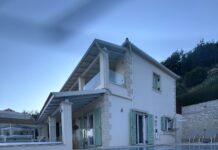
Accommodation skews toward villas and a handful of small, family-run hotels rather than resorts — which suits the solo traveller with standards. A well-positioned villa above Atherinos or Spartochori gives you a terrace, a view of the Prince Islands scattered across the strait, and total command of your own mornings. Book early for June and September; the island’s smart money travels in shoulder season, when the water is warm, the light is long, and the August flotillas have gone home.
Practicalities: fly to Preveza (Aktion), forty minutes by car to Nidri, then the ferry. There is no airport transfer apparatus, no luggage concierge, no app. You will manage, and the managing is part of the recalibration.
The honest verdict
Meganisi will not entertain you. There is no archaeological site of consequence, no nightlife beyond a second carafe, no shopping beyond olive oil and honey. What it offers instead is rarer: an intact island, indifferent to your presence in the most hospitable way imaginable, where a week alone feels less like solitude and more like good company you happen to have brought with you.
Some islands you visit. This one you’re permitted to join, briefly, on its own terms. Take the morning ferry. Let the rope-against-wood sound do the rest.