






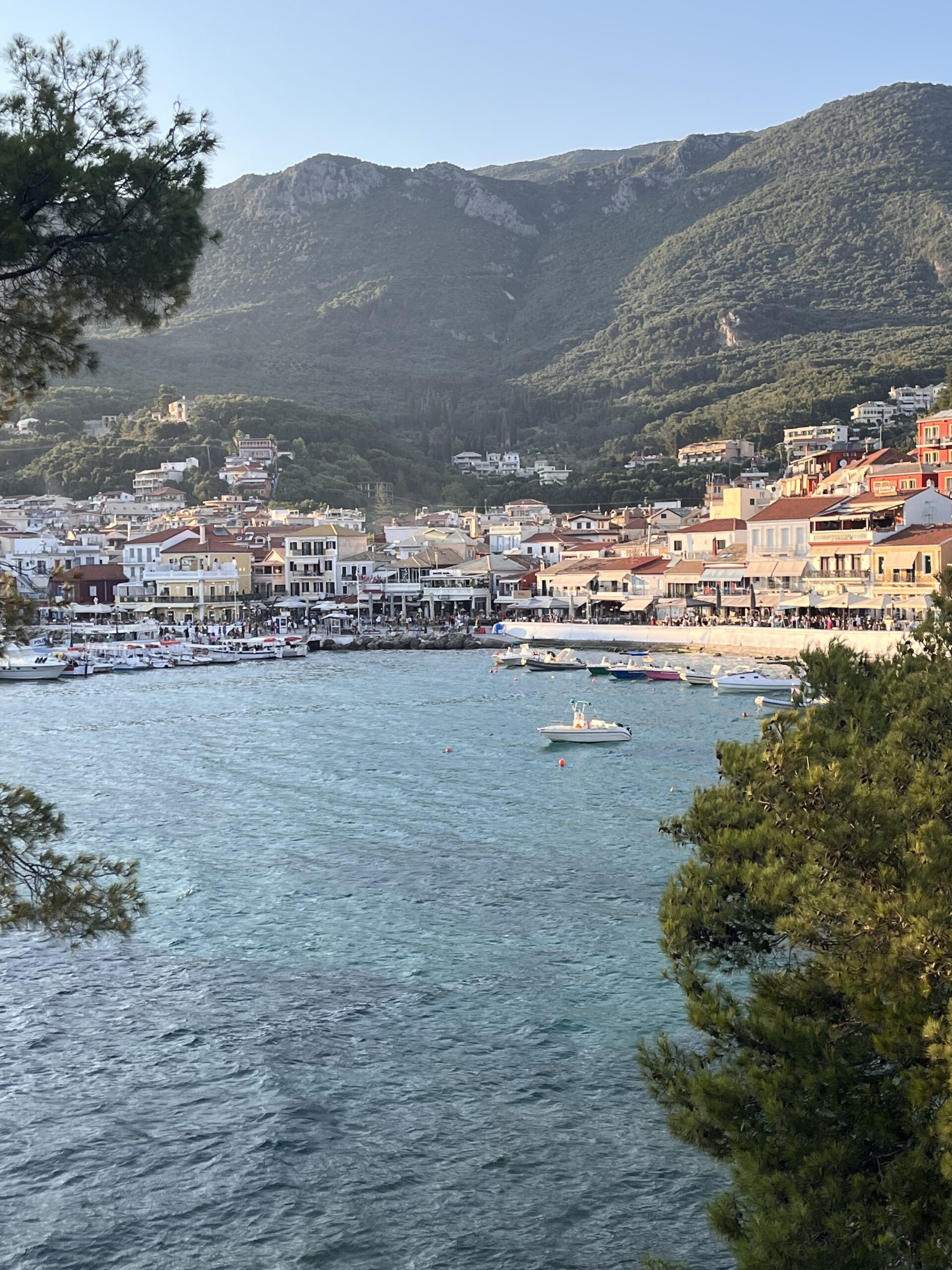
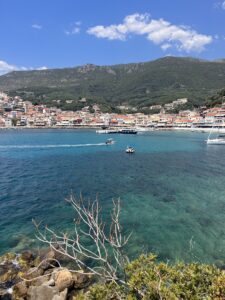
There’s a particular half-hour in Parga, just as the sun drops behind the castle, when the whole amphitheatre of the town turns the colour of a ripe apricot and the tavernas along the harbour start to fill. I’ve watched it more times than I can count over fifteen years, and it still stops me. People keep telling me the unspoilt, characterful Greece they remember is gone — paved over, packaged up, priced out. They’re wrong. It’s still here. It’s just that most of them are looking on the wrong islands.
Parga, Greece is the answer I give more than any other when someone who’s travelled a lot asks me where to go next. Not because it’s undiscovered — it isn’t — but because it has held on to the thing the famous islands have quietly traded away: a sense of place that doesn’t feel arranged for you. This is an honest guide to it, written by someone who knows the difference between the beaches worth your morning and the ones worth skipping, and who’ll tell you when not to come.
Why Parga, Greece is worth the trip
https://www.instagram.com/p/ChaJJU4LpXo/
First, geography, because it explains everything. Parga isn’t an island. It sits on the mainland coast of Epirus, in the far northwest of Greece, looking out across the water to Paxos. That single fact is the whole reason it feels different. The mainland setting gives it a backbone the islands lack — a working town with a hinterland of mountains and rivers behind it — while its position on the Ionian gives it the light, the sea and the boat trips you came for.
The town itself is built like a theatre, houses stacked up a steep hillside in tiers of ochre and white, bougainvillea spilling over everything, a Venetian castle crowning the top and a horseshoe harbour at the bottom. It is genuinely beautiful in a way photographs flatten. And because it never became a single-airline package monoculture the way parts of Corfu did, it has kept a real town’s rhythm: locals doing their shopping, fishermen actually fishing, a square that belongs to the people who live there as much as to the people visiting.
If you’ve “seen everything,” if Santorini felt like a queue with everyone taking the same Oia sunset shot and Mykonos felt like a expensive bill this is a great option.
The town and the castle: 200 years of drama above the bay
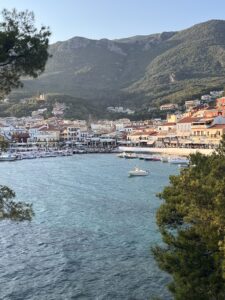
Climb to the Venetian castle in the early evening, before the light goes, and you get the best view in town for the price of a steep ten-minute walk. But the castle is worth more than its panorama, because the story attached to it is one of the most extraordinary — and least told — in this corner of Greece.
For centuries Parga was a fortified outpost, Venetian then briefly French then under British protection, holding out against the Ottoman mainland at its back. Then in 1819 the British did something the town has never quite forgotten: they sold it to Ali Pasha, the ferocious Ottoman governor of Ioannina the Parganots had spent generations resisting. Rather than live under him, almost the entire population chose exile. Before they sailed for Corfu, they exhumed the bones of their own dead, burned them, and carried the ashes with them so that nothing of their families would be left behind for Ali Pasha to desecrate. The town you’re standing in was, for a time, emptied by grief and defiance.
I tell people that story before they climb up, because it changes what you’re looking at. This isn’t a pretty stage set. It’s a place that has been fought over, lost, and slowly reinhabited.
If the castle whets your appetite, the larger, more brooding Anthousa castle sits inland on the ridge above Parga — Ali Pasha’s own fortress, built to watch the town he’d bought. Few visitors bother. It’s worth the short drive for the view back down over the bay alone.
Parga’s beaches, ranked honestly
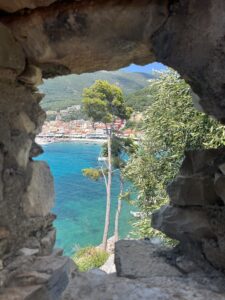
Most guides list Parga’s beaches as if they’re interchangeable. They aren’t, and pretending otherwise is how people waste a day. Here’s how I actually rank them.
Valtos — the one you came for
Over the headland from the harbour (walk it in fifteen minutes, or take the little water taxi) is Valtos, a long sweep of beach backed by tavernas with the castle watching over the far end. This is the big one, the one that earns Parga its reputation, and the one I’d point a first-timer to. Go in the morning before the loungers fill.
Krioneri — the town beach with a chapel you swim to
https://www.instagram.com/p/ChFixI1vTUj/
Krioneri is the small beach right beside the harbour — convenient, family-friendly, and home to Parga’s signature trick: the little islet just offshore, Panagia, with its tiny white chapel, which you can swim out to in a few minutes. I usually pick up an inflatable with the variety of local shops and put my food and drinks on it to swim over with! Half the photos you’ve seen of Parga feature it. It’s lovely, but it’s small and it gets busy; treat it as a between-tavernas dip rather than a whole-day beach.
Lichnos — where I go to escape
A few minutes south, tucked into its own cove, Lichnos is the one I send people to when they want quiet and a long lunch. Backed by tavernas, reachable by road or by the boats that run from the harbour, it has space to breathe even in high season.
The ones further out
For more seclusion, Sarakiniko and Piso Krioneri reward the small effort it takes to reach them.
The day trips that make Parga a base
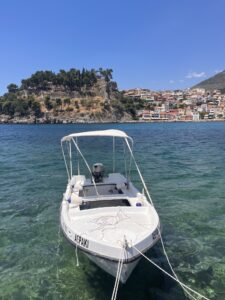
Parga is not just a place to be, it’s the best base on this coast for some of the finest day trips in Greece. Stay here, and the Ionian opens up.
Paxos & Antipaxos
The boats leave Parga harbour most mornings in season for Paxos and Antipaxos, and it’s the trip I’d protect above all others. Antipaxos has water the colour of a swimming pool — Voutoumi and Vrika are the beaches — and Paxos has the sea caves and the harbour villages of Gaios and Loggos. If you do one thing beyond Parga itself, do this.
Sivota and the Blue Lagoon
Up the coast toward Igoumenitsa, the little resort of Sivota and the much-photographed Blue Lagoon (Bella Vraka) are an easy half-day, by boat or by car.
The Springs of Acheron — the mythological gateway to the underworld
https://www.instagram.com/p/ChkcOhVPkji/
Inland, behind Parga, runs the Acheron, the river the ancient Greeks believed souls crossed into Hades. The springs where it surfaces are startlingly cold and clear, set in a green gorge, and you can wade up the river, raft it, or ride horses along it. It’s the trip that surprises people most, because it’s the opposite of a beach day: cold mountain water, plane trees, myth underfoot. It’s often busy and prepared for in parts some deeper, colder water but it’s so beautiful and absoutely worth spending half a day at. You can take a drink at the reiverside bar or even do a little river rafting.
The Necromanteion
Near the river’s mouth at Mesopotamos stands the Necromanteion of Acheron, the ancient oracle of the dead, where pilgrims once came to consult the spirits of the departed. It’s a modest but atmospheric site and paired with the springs it makes a genuinely memorable day that can be a welcome break from sunbathing.
Where to eat in Parga
https://www.instagram.com/p/ChU_IpRKze3/
Here’s something islands-only travellers don’t expect: Epirus is mainland food, and it’s different. Alongside the harbour fish you’ll find the things this region does better than anywhere — slow-cooked meat, and pita, the savoury pies Epirus is famous for. Eat at least one meal away from the obvious harbour-front and up in the town.
Where to stay in Parga — the honest version
Where you sleep changes your whole trip here, and the right answer depends entirely on what you’re after.
- Harbour and town: in the thick of it — steps from the tavernas and the evening passeggiata, with the trade-off of some noise and a climb to your door.
- Valtos: wake up on the big beach, a short walk or water-taxi from town. My pick for a first visit.
- Lichnos and the quieter coves: for couples and anyone whose idea of a holiday is fewer people, not more.
After fifteen years here I’ve built up a black book of the places I actually trust, the small hotels and villas that get it right, run by owners I know rather than whatever the booking sites push to the top. If you’d like me to point you toward the right one for how you travel feel free to reach out.
Getting there and when to go
Getting there. The closest airport is Preveza (Aktion), roughly an hour or so to the south, the simplest arrival in summer and book a taxi. I’ve done that on every visit. The alternative is to fly to Corfu, which has far more flights, then take the ferry across to Igoumenitsa and drive down the coast. The ferry port at Igoumenitsa is the nearer of the two crossings to Parga.
When to go. Late May, June and September are the sweet spot, warm sea, full life in the town, none of the August crush. July and August are beautiful but busy and hot; if that’s your only window, book early and start your beach days early. Out of season much of the harbour shuts so this, like a lot of Greece, is a spring-to-autumn town.
Final word
Come back to that half-hour at sunset — castle going gold, chapel islet catching the last light, the harbour filling up. That’s the Greece people think no longer exists, and it’s been here the whole time, an hour from an airport, looking out at Paxos. Parga rewards the traveller who’s done the famous islands and wants the thing underneath the postcard: a real town, a proper coast, and a story or two worth climbing a hill for.
FAQ
Is Parga, Greece worth visiting? Yes,particularly if you’ve already done the famous islands and want somewhere with more character and fewer crowds. Its mainland setting, Venetian castle, strong beaches and exceptional day trips (Paxos, the Acheron springs, Preveza, Lefkada) make it one of the most rewarding bases on the Ionian coast.
How many days do you need in Parga? Four to five is the sweet spot, a day or two for the town and its beaches and to settle into the vibe, plus the Paxos & Antipaxos boat trip and the Acheron springs. A week if you want to slow down and add Sivota and the Necromanteion.
What’s the best time to visit Parga? Late May, June and September when it’s warm enough to swim, lively but not crowded. August is busiest and hottest. The town largely closes out of season.
How do you get to Parga? Fly to Preveza (Aktion) airport, and take a taxi, around an hour south, or fly to Corfu and take the ferry to Igoumenitsa and drive down.
Which beach in Parga is best? Valtos for the classic Parga beach day, Lichnos for somewhere quieter with a long lunch, and Krioneri for a quick dip and the swim out to the Panagia chapel islet.