








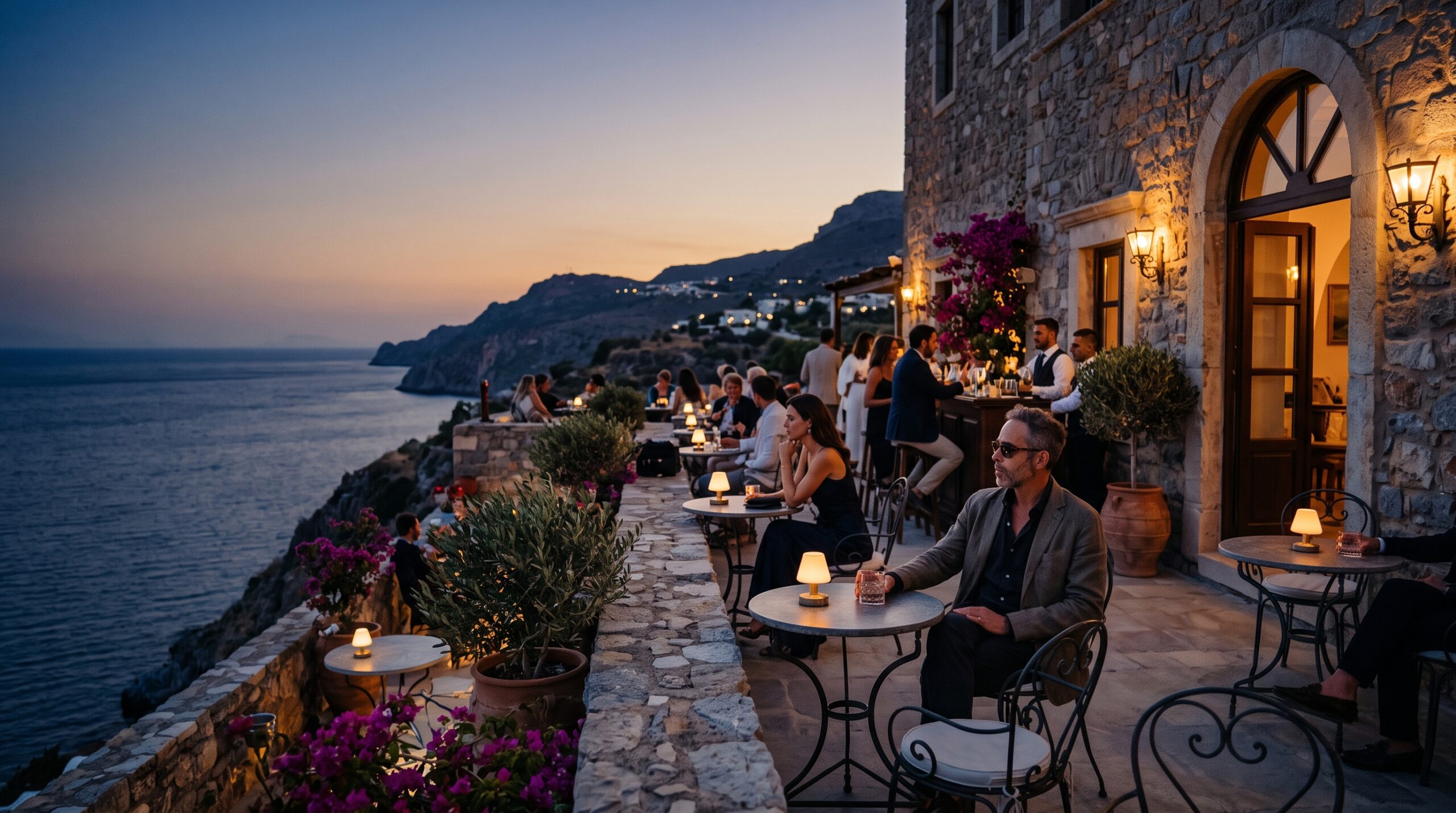

There is a precise moment on any journey when the tether to your everyday life snaps. When you embark on luxury solo travel over 40, that departure rarely happens at thirty-five thousand feet, nor when the porter closes the heavy oak door of your suite and leaves you with the quiet hum of climate control and an undisturbed king bed.
It happens around ten in the evening, on a low-slung leather stool at a hotel bar you will never visit again.
The bartender sets down a Negroni,clear ice cube, wide orange twist, the bitter bite of Campari cutting cleanly through the gin. To your left, a woman in an unbuttoned cream linen blazer glances up from her book, catches your eye in the mirror behind the bottles, and asks a straightforward question about the wine list.
At home, you are an archive.
Your partner knows your cadence, your tired grievances, the way your voice shifts when a client emails on Sunday afternoon, and precisely how many minutes you will linger over coffee before standing up. That domestic familiarity is precious; it is the mortar of a life built over fifteen or twenty years. But it is also an anchor. It settles you into a version of yourself that is predictable, thoroughly mapped, and entirely without mystery.
Across this dark marble counter, however, none of that architecture exists.
The Intoxicating Weightlessness of the Clean Slate
When you travel alone over forty, conversation with an attractive stranger carries a peculiar, electric charge that has very little in common with the frantic flirtations of youth. In your twenties, you are trying to prove what you might become. In your forties, you carry the effortless gravity of someone who already knows what they do well.
The stranger sitting next to you doesn’t know your mortgage rate, your back pain, or the quiet negotiations that govern your domestic life. When you speak, they do not anticipate the punchline of your story before you reach it. They listen with an intensity that feels almost subversive—leaning in slightly over the rims of their glasses, caught off guard by your dry observation, treating you not as an accustomed fixture, but as an intriguing mystery waiting to be unspooled.
It is intoxicating not because you crave a different partner, but because you crave the person you are when no one is holding you to your history.
The Architecture of Permission
Luxury travel is specifically engineered to manufacture this vulnerability.
High-end hotels and secluded villas are frictionless bubbles designed to strip away consequence. There are no laundry hampers, no buzzing dishwashers, no shared calendars signaling tomorrow’s school run or quarterly review. The ambient lighting is warm and conspiratorial; the staff glide by on quiet soles; the soundtrack is discreet jazz and clinking crystal.
In this environment, moral geography becomes strangely flexible. You are a ghost moving through someone else’s city. If you stay for another drink, if your fingers brush against theirs as you reach for the bowl of green olives, if you linger on the courtyard terrace while the night air turns cool—who is there to record it?
The temptation in these rooms is rarely a crude physical urge. It is the much more dangerous seduction of erotic validation—the sudden reminder that you are still capable of generating friction, curiosity, and heat in an entirely new human being.
The Decision at the Lift
By midnight, the conversation has moved past polite inquiries about flights and itineraries. It has deepened into the territory reserved for people who know they have limited hours together: honest admissions about work, quiet confessions about restlessness, the shared recognition that you both belong elsewhere.
Then comes the inevitable pause. The bill is signed to a room number. The walk toward the elevators is slow, measured, each floor tile echoing the question neither of you has had to ask out loud.
This is the sharpest edge of midlife solo travel: standing before mirrored brass doors with a keycard in your pocket, looking at someone whose eyes are bright with open-ended possibility, and deciding where the fantasy ends.
The Art of the Near-Miss
In your twenties, restraint feels like defeat. If an evening doesn’t culminate in a shared room, the night is categorized as a failure of courage or opportunity.
In your forties, restraint is the entire aesthetic.
There is a quiet, aristocratic pleasure in understanding the difference between an urge and a reality. When you stand outside that elevator, the thrill isn’t that you must take the step across the threshold; the thrill is remembering that you could.
The mature solo traveler learns to treat temptation not as a siren song to succumb to, nor as a mortal sin to flee in panic, but as a mirror. The stranger across the bar is not offering you a new life; they are offering you a clean projection of your own vitality. They are admiring the version of you that is untangled from domestic stress, well-dressed, attentive, and bathed in flattering amber light.
To take them upstairs is to drag that pure, weightless fantasy straight down into the messy mechanics of reality—awkward morning-after logistics, transactional departures, and an immediate ledger of guilt that ruins the retreat you paid dearly to enjoy.
Stepping into the lift alone, wishing them a pleasant onward journey, and letting the brass doors close between you isn’t puritanism. It is narrative control. You leave the scene at its absolute peak, intact and unresolved, suspended in amber.
The Threshold at Terminal 5
The actual test of a journey like this never takes place in Rome, Florence, or Athens. It happens seventy-two hours later at international arrivals.
You collect your luggage from the carousel. You take the train or the car service through grey motorway drizzle. When you turn the key in your front door, the sensory contrast hits like a wall: the scent of cedar and familiar detergent, the dog barking in the hallway, the stack of unread post on the table, and your partner walking out of the kitchen with a mug in hand.
“How was the trip?” they ask.
They want to hear about the boutique estate, the quality of the terrace views, whether the weather held, and if the flight was on time. You will tell them all of those things, and every detail will be true.
What you cannot articulate,and what you shouldn’t try to,is the strange, phantom ache humming beneath your skin. It is not regret. It is not the wish that you were waking up beside a stranger in an unfamiliar suite. It is the subtle, private grief of stepping back into your established skin and hanging the unencumbered self back in the wardrobe like a tailored linen coat.
Bringing the Voltage Home
The mistake many long-term partners make after travelling alone is treating that revived pulse as a guilty secret to bury under domestic chore lists.
A committed relationship does not wither because of distance; it withers from the suffocating assumption that you have already seen every dimension of the person sitting across the breakfast table. When you return from a solitary trip carrying the quiet knowledge that you are still desirable to the outside world, you carry a latent voltage.
You look at your partner not through the foggy lens of shared household administration, but as someone you actively choose over every fleeting alternative the world just put in your path.
Solo travel doesn’t threaten a solid foundation—it recalibrates its value. You went into the dark, you saw the flame, and you had the elegance to finish your drink, leave a generous tip, and return home with your secrets and your loyalty entirely intact.