







Everyone calls it brave.
The colleague who raises an eyebrow when you mention you’re going to Greece alone. The acquaintance who says “oh, I could never do that” with the particular inflection that makes it unclear whether she’s expressing admiration or something closer to pity. The well-meaning friend who asks if you’re sure, as if certainty about your own plans requires external validation. The travel article — you’ve seen it a hundred times — that frames solo travel for women over 40 as an act of quiet courage, a reclaiming, a statement about independence.
Here’s a more useful framing: it isn’t brave. It’s just better.
Better than negotiating where to eat. Better than compromising on the hotel because someone else doesn’t see why it matters. Better than building your itinerary around another person’s energy levels, pace, or particular obsession with visiting every church in a ten-mile radius. Solo travel over 40 isn’t a consolation prize for the unpartnered or a personal challenge for the intrepid. It’s a considered, deliberate choice — and increasingly, it’s the choice that experienced women are making precisely because they’ve reached the point where they can afford, in every sense, to travel the way they actually want to.
The word “brave” is rarely applied to a man eating alone at a good restaurant, or booking himself into a villa for a week, or disappearing to Portugal for ten days without a companion. It is applied, persistently and with baffling regularity, to women doing exactly the same thing. The implication — that solo travel is a feat of endurance for women in a way it simply isn’t for men — deserves to be dismissed once, clearly, and then ignored completely.
This guide is written for women who have already dismissed it. Or are about to.
Why 40 is the inflection point, not the obstacle
There’s a persistent narrative that travel gets harder as you get older — that the window for solo adventure closes somewhere around the point you accumulate responsibilities, opinions, and a genuine preference for thread-count. This is, to be direct about it, completely backwards.
What you actually accumulate by 40 is the one thing that makes travel transformative rather than merely pleasant: the ability to know what you want and go after it without apology.
You’re not going to end up in the wrong hotel because you couldn’t bring yourself to pay more. You’re not going to spend three days in a place you hate because it felt impolite to leave. You’re not going to eat at a mediocre restaurant because everyone else voted for it. And you’re not going to spend the first two days of a trip quietly managing another person’s anxiety about travel — their worry about the transfer, their adjustment to the new time zone, their lukewarm feeling about the destination you’ve been thinking about for a year.
The self-knowledge that comes with 40-plus years of being alive is, in travel terms, extraordinary power. Women tend to underestimate how much of it they’ve accumulated.
The numbers have quietly caught up with this reality. Research consistently shows that women now make up the majority of solo travellers — and the fastest-growing segment within that group is women over 45. The luxury travel industry has started to notice. Hotels that once defaulted to couples-centric design are building suites with reading nooks and solo-friendly dining configurations. Villa agencies are seeing single bookings for full properties — not a compromise, but a deliberate choice to have the pool to yourself.
This is not a trend. It’s a correction.
What actually changes when you travel alone over 40
There is a version of this section that talks about self-discovery and finding your inner compass. This isn’t that version.
What changes, practically and meaningfully, is this:
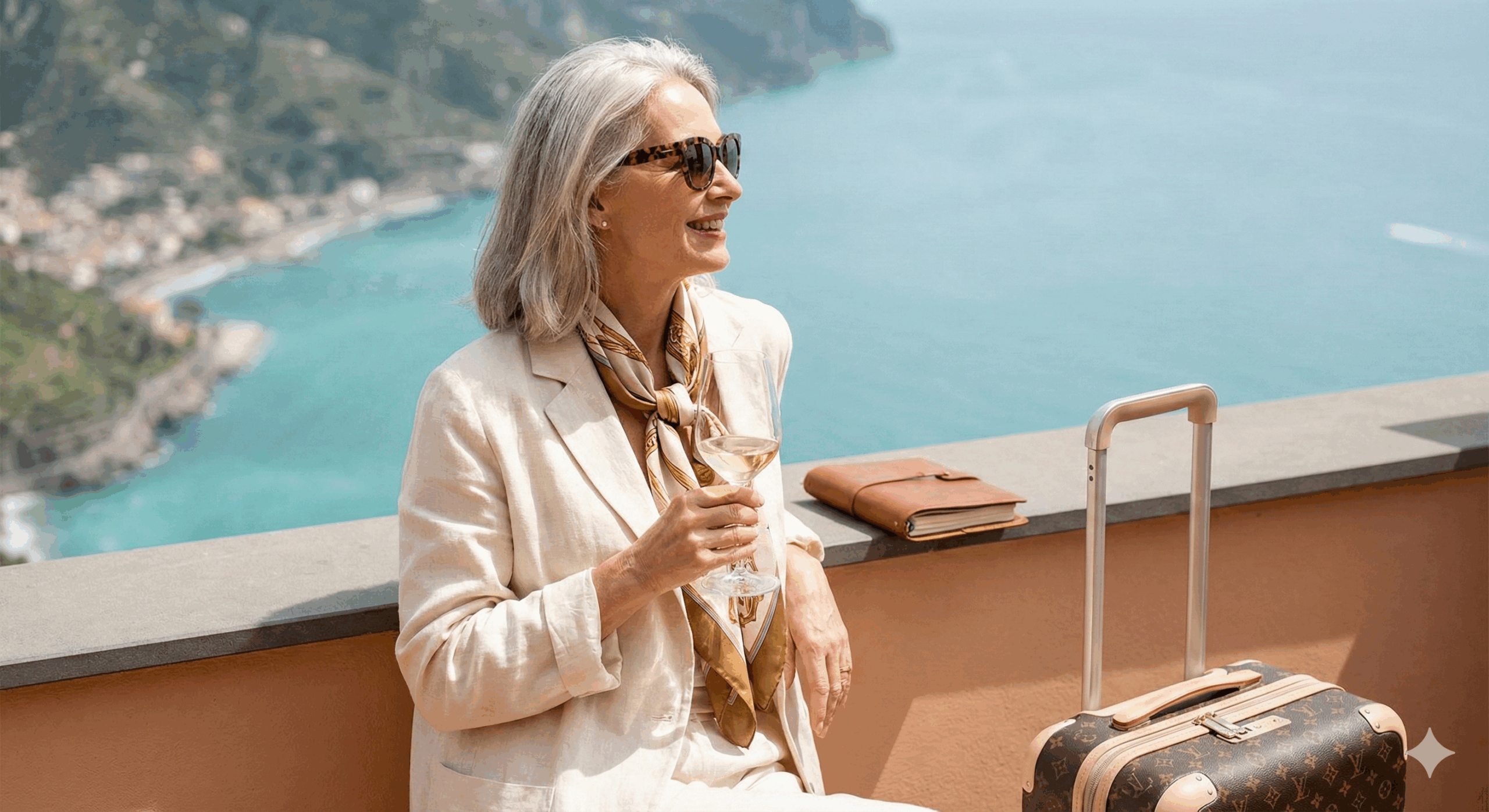
You stop performing the trip. When there’s no one else to factor in, travel becomes less about the itinerary and more about the experience of being somewhere. You notice more. You slow down more readily. You sit at a harbour with a glass of something cold and actually look at the water, rather than narrating it to a companion or checking whether they’re bored. Solo travel removes the obligation entirely. It turns out the water is considerably more interesting when you’re just watching it.
You make better decisions about where to stay. This is worth dwelling on, because accommodation choices are the single biggest determinant of how a trip feels. When you’re travelling alone, you stop compromising on the property. There’s no internal negotiation between your preference for a private villa with a terrace and someone else’s reasonable question about whether that’s overkill for one person. It isn’t overkill. It’s the whole point. A well-chosen villa — staffed, private, positioned correctly changes the texture of a trip completely. You have a home rather than a base. You eat breakfast on your own terms. You swim when you want to, in water you’re not sharing with anyone.
You meet people differently – the paradox of solo travel that nobody adequately prepares you for is that you meet far more interesting people travelling alone than you do travelling with a companion. A companion is a social buffer; remove the buffer and you’re suddenly available , to conversations with locals, to the woman at the next table who turns out to be fascinating, to the other solo traveller you’d never have approached if you’d had someone to talk to. Over 40, you’re better at making these connections count rather than collecting them. You know which conversations are worth extending over a second glass of wine.
You waste less time.Time spent in indecision, compromise, or managing another person’s difficult morning is not trivial over the course of a week. Solo travel hands that time back entirely. The solo female traveller over 40 is perhaps the most efficient traveller in existence — she knows what she’s there for, she makes decisions quickly, and she doesn’t spend two hours in a restaurant because she’s waiting for the group to agree on something.
The objections, answered honestly
Isn’t it lonely?
Sometimes, briefly. The most common moment is dinner on the first evening of a trip — there’s a particular quality to the first solo dinner that’s hard to describe: something between liberation and the faint sense that you’ve forgotten how to just sit with yourself. It passes, usually within twenty-four hours. What replaces it is something closer to contentment than loneliness — a quiet satisfaction with your own company that becomes, over time, one of the better side effects of travelling alone.
The practical answer: choose your accommodation and destinations deliberately. A private villa with a housekeeper who knows the area, a restaurant where the owner greets solo diners with actual warmth rather than a table by the kitchen — these choices matter. So does choosing destinations with genuine social infrastructure: small islands where the harbour is the social centre, towns with a good bar culture, places where a woman sitting alone with a book is understood to be reading, not waiting.
Is it safe?
For women travelling in good accommodation in established European destinations — the Mediterranean, the Greek islands, coastal Italy, the south of France — the day-to-day reality of solo travel is considerably less dramatic than the question implies. You exercise the same judgement you’d exercise anywhere: understand your surroundings, trust your instincts, make sensible decisions about where you go and when.
What shifts over 40 is the quality of that instinct. You’ve spent decades reading rooms, reading people, noticing when something is off. That calibration is worth more than any amount of general safety advice. You are not more vulnerable because you’re alone; you’re arguably more alert and considerably less likely to talk yourself out of what your gut is telling you — which is the mistake most often made by people who find themselves in genuinely difficult situations.
The specifics: stay in quality accommodation with good security and staff who know you’re travelling alone. Choose destinations with a genuine tourist infrastructure rather than somewhere truly remote on a first trip. Tell someone your itinerary. Check in when you arrive somewhere new. These are not extraordinary precautions — they are simply the mechanics of travelling well.
Is it more expensive?
Yes, in some respects. The single supplement — the travel industry’s legacy charge for the inconvenience of being one rather than two — remains a legitimate frustration. A hotel room that costs £300 for two people frequently costs £250 for one, which is its own kind of commentary on the industry’s assumptions about who travels alone and why.
But the picture is more nuanced than the headline cost suggests. When you’re travelling alone, you stop splitting costs and start making entirely different choices. The villa that seemed expensive for two people makes different sense for one person who actually wants to be in it all day. Dining alone, you order exactly what you want, drink what you want to drink, and leave when you’re ready — there’s a financial efficiency to this that partially offsets the supplement. And the luxury end of the market has been slower to enforce punitive solo premiums than mid-range accommodation; a number of boutique hotels and villa operators have quietly dropped the supplement entirely, particularly for shoulder-season bookings.
What will people think?”
Here’s what they actually think, in practice: that you’re someone who knows what she’s doing. Solo women travelling well — staying in good places, eating in good restaurants, moving through destinations with the ease that comes from having planned the trip yourself — read as confident rather than sad. They read as interesting. They occasionally read, to the right observer, as someone worth talking to.
The pity narrative that surrounds solo female travel is almost entirely a projection from people who haven’t done it. The reality, in a good restaurant or a beautiful place, is considerably more flattering. Women who’ve travelled solo for years will tell you the same thing: you stop caring what people think within about forty-eight hours, and after that point, the only opinion that interests you is your own.
That tends to arrive much faster after 40 than it did before it.
Where to go: destinations that reward the solo female traveller over 40
Not every destination is equally suited to solo travel over 40. What you’re looking for is a specific combination: safety and ease of navigation, genuine quality at the accommodation level, social infrastructure that doesn’t depend on a group, and enough depth to sustain a slower pace.
Here’s how the Mediterranean breaks down through that lens.
The Greek islands — with caveats
Greece is the obvious answer, but the right Greek island matters enormously. The popular islands — Mykonos, Santorini in August, Ios — are engineered for groups and couples, and the experience of navigating them alone can feel strangely alienating despite, or sometimes because of, the crowds.
The islands that reward solo female travel over 40 are the quieter ones. Kefalonia — with its serious wine, its dramatically good beaches, and its lack of the package-holiday infrastructure that flattens everywhere else — is one of the best in the Ionian. Meganisi, barely known outside Greece, operates at such a different pace that the concept of loneliness barely applies; it’s too beautiful and too genuinely welcoming to leave much room for it. Naxos. Sifnos. Alonissos. Islands where the taverna owner knows your name by day two and the sea is cold enough to actually wake you up.
Women travelling solo in the Greek islands report, consistently, that the warmth extended to a solo woman eating alone at a family-run taverna is considerably more genuine than anything on offer at a tourist-facing establishment. The smaller the island, usually, the truer this is.
Coastal Italy
The Amalfi Coast is crowded and logistically punishing in high summer, but outside July and August it’s extraordinary — and the Italian attitude toward solitary dining is the most sophisticated in Europe. A woman eating alone in a serious Italian restaurant is not a subject of concern; she is a guest who is afforded exactly the same attention as anyone else at the table, which is to say, considerable attention. You are offered the good table, the good wine list, and the assumption that you know what you’re doing, which you do.
The Puglia coast, the Aeolian Islands, the lesser-known stretches of Calabria: all excellent, all under-represented in the English-language travel press, all considerably more rewarding for the solo female traveller than their more famous neighbours.
Southern France and northern Spain
The Basque country — both Spanish and French sides — is perhaps the finest destination in Europe for solo travel over 40. The food culture is serious enough to be worth the trip on its own terms; the social life of the pintxos bar is inclusive and easy to navigate alone; and the landscape, particularly inland, is unhurried in ways that are increasingly rare in southern Europe.
Provence works well in late spring and early autumn. Biarritz in September is one of the more quietly elegant solo travel experiences available in Europe — the kind of place where a woman reading on a terrace in good light is simply part of the scenery, in the best possible sense.
Portugal
Portugal has become, over the past decade, one of the most reliably excellent destinations for the solo female traveller — safe, genuinely hospitable, and with an accommodation offering that has improved dramatically. The Alentejo is particularly good for a certain kind of slow travel: farmhouse stays, long lunches, afternoons where nothing is required of you. Sintra, the Douro Valley, the western Algarve in shoulder season — all of them excellent, and all of them places where a woman travelling alone is neither unusual nor the subject of anyone’s concern.
How to travel: the practical architecture of a solo trip over 40
Invest in the accommodation
This is the one non-negotiable. When you’re travelling alone, you live in your accommodation more fully than you do when travelling with someone — it becomes your living room, your reading room, your place to decompress at the end of a day without having to manage anyone else’s decompression alongside your own. A disappointing room is considerably more disappointing when you’re the only person in it.
The best formats for solo travel over 40, in rough order: private villa with staff (the gold standard — your home, your pace, someone who knows the local area and can make a restaurant reservation or organise a boat day without you having to work for it); boutique hotel with a genuinely welcoming bar and staff who treat solo guests as guests rather than anomalies; well-positioned apartment in a town rather than a resort.
What to avoid: anywhere designed primarily for couples, where you’ll feel the infrastructure’s low-level confusion at your presence; large resort hotels without real social spaces; anywhere where dinner alone at the on-site restaurant means a table in a corner and a waiter who checks on you with the frequency reserved for people who might leave.
Choose your pace deliberately
One of the genuine gifts of solo travel is the ability to set your own tempo — but it’s worth doing this explicitly rather than accidentally. Decide before you arrive: is this a week for going deep in one place, or a week for covering ground? The mistake is neither — drifting between two half-formed intentions and arriving home with a trip that felt busy without being satisfying.
The slower option is almost always better. One Greek island properly explored beats three glimpsed. A single Provençal village known well beats the Provence greatest-hits loop. This is obvious in retrospect and consistently underestimated in advance.
Build in social touchpoints
Not every moment needs to be solitary. Cooking classes, guided walks, wine tastings, boat days — these are the social anchors that give a solo trip texture and variety, and they’re also where the most interesting conversations happen. Book at least one or two per week, not because you need the company but because the contrast makes the solitary time feel more deliberate rather than simply default.
Tell someone where you are
Basic, sensible, and not a solo-female-travel concern specifically — just the mechanics of travelling well. A quick message when you arrive somewhere new costs nothing and matters if anything goes wrong.
Where to start
If you’re planning your first — or next — solo trip over 40, the practical starting points:
- Destinations to consider first: Kefalonia, the Amalfi Coast in May, the Basque Country in September, Lisbon in spring. All easy to navigate alone, all excellent at the accommodation level, all able to absorb a week of slow, unhurried attention.
- Accommodation: Look beyond hotels. A private villa for a week — even, especially, for one — reconfigures the entire experience. [→ See: Solo villa holidays: what the booking platforms won’t tell you]
- What to read before you go: The Refined Edit covers specific destination guides built around first-hand stays — including Kefalonia and Meganisi, coming this summer — with honest assessments of where to stay and what to skip